









The Future of Legal WorkTM

Lawyers are expensive. Our AI reviews legal contracts for free.

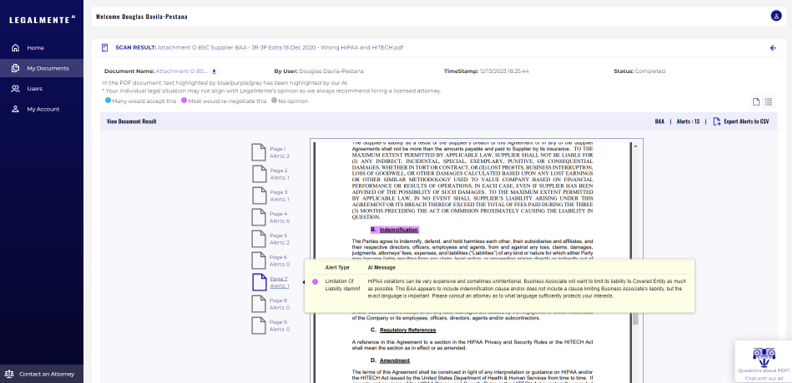
LegalMente AITM reads and analyzes your legal contract and lets you know of any issues in seconds.

AI-Automated Contract Review

Our innovative software uses cutting-edge AI technology to read and analyze common healthcare and venture capital contracts (Business Associate Agreements, Non-Disclosure Agreements, Simple Agreements for Future Equity) with precision and speed.

By harnessing the power of AI, Natural Language Processing (NLP), and Large Language Models (LLM), LegalMente AI can quickly detect potential legal issues within a legal contract and alert customers in minutes, not days.

This Patent Pending breakthrough technology follows the actual steps a legal mind would take when reviewing an agreement, but at just a fraction of the cost.

Our AI also has guardrails against hallucinations to ensure accurate output.

Powered by our Proprietary AI and ChatGPT

LegalMente AI is part of Meta’s Open Loop program that follows the NIST AI Risk Management framework

Trained On Expert Legal Minds

LegalMente AI is programmed to go through a legal playbook, highlighting issues and providing an easy-to-understand explanation for each concern. This level of detail ensures that our clients can make informed decisions about their healthcare and venture contracts without incurring excessive legal costs.

Additionally, lawyers can use LegalMente AI to speed up their own review time.

Organizations using our AI to save on legal costs

Who can benefit from LegalMente AI?

LegalMente AI is designed for anyone who deals with healthcare and venture capital contracts, including:

Physician Offices

Nursing Homes

Hospitals

Other healthcare providers

physical therapy, imaging centers, etc.

Healthcare vendors

Billing companies

Startups

Investors

Independent healthcare contractors

In-house healthcare lawyers

Law firms specializing in healthcare

Running a company is hard. Huge legal bills makes it harder.

With LegalMente AI, you can confidently navigate the complex world of legal contracts in healthcare and venture capital while saving time and money and having peace of mind. Let our advanced AI technology do the work for you, and experience the difference LegalMente AI can make in your business.

Blog

How Many Shares Should Your Startup Authorize Upon Launch

New startups often launch with 10 million authorized shares. Founders often ask me, “Why 10 million shares?”  Before answering how many shares of stock a new startup should issue, founders must first understand the difference between authorized, issued, and outstanding shares.  What Is The Difference Between Authorized, Issued, and Outstanding Shares? The number of authorized shares is the maximum number of shares that a corporation is legally allowed to issue to its investors and stockholders.  When a corporation is formed, founders will submit a certificate of incorporation (also called the “charter”) to the appropriate Secretary of State.  Among other things, the charter includes the maximum number of shares that the corporation is authorized to distribute or “issue.”  Issued Shares are the number of authorized shares that the corporation has actually issued to all its stockholders. Legally speaking, the number of issued shares cannot be greater than the number of authorized shares.   Outstanding shares are the issued shares that are currently outstanding. After being issued, a corporation may buy back shares that then are no longer outstanding.   Think Of The Number Of Authorized Shares As Your Company’s Share “Limit”  The number of authorized shares is much like a credit limit on a credit card.  Let’s say you have a $5,000 credit limit and your ABC Corporation only has 5,000 shares authorized.  The $5,000 limit is like the number of authorized shares — you cannot spend more than $5,000 credit limit, just like ABC Corporation cannot sell or grant more than 5,000 shares.   Starting with its 5,000 authorized shares, let’s say ABC Corporation issues 2,600 shares. This is like the company spending $2,600 of its $5,000 “credit limit.”  You have $2,400 left to spend in your credit line, and ABC Corporation has 2,400 shares left to issue.  Issuing more shares than there are authorized makes those additional shares voidable.  To issue more shares once you have reached the authorized limit, you need to amend the corporation’s charter, which usually requires approval from the board of directors and at least a majority of the existing stockholders (or whatever approval process the company’s charter or bylaws states).   The stockholders might not be eager to approve of this change because increasing the number of authorized shares allows for the possibility to issue more shares that can dilute the ownership of existing stockholders.   How Many Shares Do Startup Founders Need To Issue?  The commonly accepted standard for new companies is 10 million shares.  When you build a venture-backed startup designed to scale, you will need to issue shares to an increasing number of employees.   Authorizing 10 million shares means it will be unlikely you’d ever need to offer someone a fraction of a share.  A company can grant 10,000 shares to an employee which represents just 0.1% of 10 million shares.  Psychologically, that works much better than giving ten shares which would be 0.1% of 10,000 shares.   Also, the price per share will be lower.  Let’s say two companies are each worth $1 million.  One company has authorized and issued 10 million shares, while another has authorized and issued 1,000 shares.  The first company would have a price per share of 10 cents per share.  The second company would have a price per share of $1,000.  As an investor, it can “feel” better to buy at a lower price.  The quoted examples assume that the number of issued shares is at the maximum number of authorized shares.  Out of a company’s 10 million authorized shares, founders are typically issued anywhere from 5 to 7 million shares.  This practice makes sure that the founders always own a majority of the issued shares even when all 10 million shares have been allocated.   To incentivize employees, startup founders reserve a percentage of the company to issue employees stock options or other equity incentives.  This reserved number of shares is called the “option pool” and is most commonly the number equal to 10 to 20% of the currently issued shares.   The remaining number of authorized shares that are not issued or reserved for issuance is available to investors, usually as preferred stock.   How Do You Calculate The Ownership Percentage Of A Startup’s Shares?  When calculating the percent ownership of a corporation, do not count the authorized shares. Instead, focus on the number of issued shares.  In the example of a startup with 10 million authorized shares, 6 million are issued equally between two founders so that each founder owns 3 million shares, or 50%, of the company.  If the founders wish to have a 10% option pool for employees, 600,000 shares are reserved for issuance as stock options (or other equity incentives).   Please note that stock options give the right to purchase shares of stock but are not actually shares of stock, so a holder of stock options has no ownership in the company until the stock option is exercised.   Summary  Investors are used to seeing 10 million shares, but you can choose any number to authorize.  The key is to have enough shares to issue additional shares to incentivize employees and to raise funds from investors without immediately having to amend your charter every time you wish to issue additional shares.   This article lays out the distinction between authorized and issued shares as well as some strategies related to allocating them, but please note that this post (1) is not provided in the course of and does not create or constitute an attorney-client relationship, (2) is not intended as a solicitation, (3) is not intended to convey or constitute legal advice, and (4) is not a substitute for obtaining legal advice from qualified professionals.  LegalMente AI – The One-Stop AI Legal ShopTM Lawyers are expensive. If you’re tired of high legal costs, you should consider using AI to help.  LegalMente AI® uses artificial intelligence to reduce the cost of legal work for small businesses, startups, healthcare, and individuals.  LegalMente’s software uses patent pending RedFlag DetectionTM AI technology to read and analyze common legal contracts with accuracy and speed.


Read More »

The 83(b) Election- What Startup Founders Need to Know

There’s a critical choice founders must make when making a Section 83(b) election. The 83(b) election is a provision under the Internal Revenue Code that gives an employee or startup founder the option to pay taxes on the total fair market value of restricted stock at the time of granting.  If one waits too long to decide, founders or employees granted company stock could face some profound tax implications.   Let’s start with the basics.  What is Restricted Stock?  While many startup companies give stock options to employees, some grant restricted stock to its founders and certain employees. Restricted Stock is granted to a stockholder but limited in that it cannot be transferred or sold by that stockholder and may even be taken back by the company until certain conditions are met. Once met, the stock is released from the restrictions and said to be “vested.”   If you are granted restricted stock, filing an 83(b) election might save you money on taxes, especially if you think the stock will become more valuable (and hence, result in a higher tax bill).  It’s helpful to know how these elections work and when they may be useful. The steps required to file an 83(b) election are relatively simple.    Should I file an 83(b) election?   After you are granted restricted stock, you have 30 days to send an 83(b) election letter to the IRS to let them know that you want the stock to be taxed on the date it was granted. Otherwise, you will pay taxes on the date the stock vests.  However, 83(b) elections may not be advantageous in every scenario. When deciding whether to file an 83(b) election, consider:     How can I file an 83(b) election?  If you decide to file, you should consult with a tax or legal professional to ensure that you correctly complete the process. To give you an idea of what’s involved, the necessary steps are:  This article is not provided in the course of and does not create or constitute an attorney-client relationship. It is not intended as a solicitation, is not intended to convey or constitute legal advice, and is not a substitute for obtaining legal or tax advice from qualified professionals. LegalMente AI – The One-Stop AI Legal ShopTM Lawyers are expensive. If you’re tired of high legal costs, you should consider using AI to help.  LegalMente AI® uses artificial intelligence to reduce the cost of legal work for small businesses, startups, healthcare, and individuals.  LegalMente’s software uses patent pending RedFlag DetectionTM AI technology to read and analyze common legal contracts with accuracy and speed. Our AI Paralegal, ParaTM, can answer legal questions, analyze multiple file types, and help you form a business.  Our Pre-Drafted Legal Document Templates contain templates for common legal contracts such as NDAs, BAAs, and SAFEs. And LegalMente AI can also help connect you to licensed attorneys. 

Read More »

How to Form an LLC – Key Steps You Must Know

Choosing the right legal structure is a critical decision for business owners in the US, and one of the most popular options is forming a Limited Liability Company (LLC).    An LLC offers several advantages, including personal liability protection, flexibility in management, and various tax options. Unlike sole proprietorships, an LLC shields personal assets from business debts and legal liabilities.   Additionally, members can choose whether to be taxed as a sole proprietorship, partnership, or corporation, depending on their financial goals.  Types of LLCs Not all LLCs are created equal. There are several types of LLCs to consider, and choosing the right one is crucial for your business structure:   Steps to Form an LLC in the United States  Additional LLC Responsibilities Forming an LLC comes with ongoing responsibilities such as filing annual reports, paying state fees, and maintaining proper records. The costs vary by state, so be sure to check local requirements. For businesses operating in multiple states, “foreign qualification” might be required to do business legally across state lines. Keeping accurate records and consulting with an attorney or legal professional is essential to ensure compliance.  Is an LLC Right for You? Deciding to form an LLC depends on your business goals. If you’re looking to protect your personal assets, offer flexibility in taxation, and simplify management, an LLC might be the perfect fit. However, it’s vital to assess your situation with professional advice to ensure you’re making the right choice for your business. LegalMente AI – The Future of Legal Work Traditional legal services have their place. However, high legal costs and inefficiencies are hard to ignore. Dealing with contract review doesn’t have to drain your wallet. LegalMente AI offers an innovative solution that addresses these challenges head-on. It provides quick, accurate, and cost-effective contract reviews.   Step up to smarter, more affordable legal reviews with LegalMente AI. Sign up for a free user account today and say goodbye to those endless legal bills. LegalMente AI is free to use for everyone so you can start saving money today. 

Read More »

Want To Avoid $500 Per Day In Fees? Then Your Business Needs To Learn About The BOI Requirement – A New National Registry of Business Ownership 

This article originally appeared in Padilla Law PLLC  In a move that has caught the attention of entrepreneurs and investors across the United States, the Corporate Transparency Act (“CTA”), which went into effect on January 1, 2024, is expected to impact more than 32 million entities.  The current administration will now require almost all startups and small businesses with state-filed entities to report their ownership details, a move that some view as unprecedented and burdensome. It is important for entrepreneurs and investors to understand how the CTA’s broad coverage could impact them since noncompliance could expose individuals to criminal and civil penalties.  What Businesses Are Affected? Any U.S. entity created by filing a document with a secretary of state or any similar office under the law of a state, such as corporations, LLCs, and LPs.   Any foreign entity registered to conduct business in the United States.  There are 23 exempt entities, such as banks, SEC-reporting companies, insurance companies, and public accounting firms. Another exemption exists for any entity that (1) employs more than 20 full-time employees in the United States, (2) reports more than $5 million of revenue from U.S. sources on a consolidated basis for the previous year, and (3) operates and has a presence at a physical office in the United States.  Any non-exempt company is considered a “Reporting Company.” Thus, this is a requirement squarely aimed at small businesses and startups.  What is the BOI Report?  In a Business Ownership Information report (“BOI Report”), a Reporting Company must furnish its (1) full legal name, (2) trade names or d/b/a names, (3) entity address, (4) formation/registration jurisdiction, and (5) federal taxpayer identification number. For more information on BOI Reports, see .  A Reporting Company must also provide details about individuals holding a direct or indirect ownership interest of at least 25% in the company or exercising substantial control over the company. The Reporting Company must provide such an individual’s (1) legal name, (2) birthdate, (3) home address, (4) identifying number from a driver’s license, passport, or other authorized documents, and (5) image of the approved document containing the identifying number.  Any individual authorized to act on the Reporting Company’s behalf may file this report.  The Purpose Of The New Requirement Is To Share With Law Enforcement  The information provided in the BOI Report is collected in order to share with law enforcement at the federal, state, and local levels, other federal regulators, or financial institutions. It is intended to enhance transparency in the ownership and control of U.S. entities to combat money laundering, tax fraud, and other unlawful activities.  Compliance Deadlines Are Fast Approaching  A Reporting Company formed before January 1, 2024, must file its BOI Report by January 1, 2025.  A Reporting Company formed on or after January 1, 2024, but before January 1, 2025, must file its BOI Report 90 days after creation or registration.  A Reporting Company formed on or after January 1, 2025, will have 30 days to file its BOI Report.  A Reporting Company has a 30-day window to amend its BOI Report with updated information.  Penalties for Noncompliance  The CTA imposes both civil and criminal penalties for noncompliance or falsified information.  Update While billed as a crime stopper, there were 23 exemptions to BOI reporting that left just startups and small businesses bearing the brunt of this new filing requirement and creep into Big Brother territory. Our CEO, José Padilla, had this to say about the news:  “This was making lawyers alot of money, and letting the government track every single small business owner… I’m glad to see this go. Big brother stifles innovation, and USA is the one of the last remaining outposts of innovation.” You can read more about the news here. This article lays out certain requirements and information related to the federal Business Ownership Information reporting requirement, but please note that this article (1) is not provided in the course of and does not create or constitute an attorney-client relationship, (2) is not intended as solicitation, (3) is not intended to convey or constitute legal advice, and (4) is not a substitute for obtaining legal or tax advice from qualified professionals.  How Can I Get Legal Assistance?  Overcoming the difficulties and confusion of complying with regulations can be difficult. LegalMente AI can assist if you require any individualized support or have inquiries regarding the filing procedure at very minimal costs. To ensure your business remains compliant, use our “Contact an Attorney” feature in LegalMente AI to receive professional guidance from a licensed attorney under your budget (such as Padilla Law PLLC.)  

Read More »

4 Ways AI Can Save Your Business Money on Legal Fees

For businesses, legal bills can accumulate quickly and endlessly. They may be for reviewing contracts and legal documents or just simply asking legal questions for due diligence.  Artificial Intelligence (AI) has emerged as a new tool in the fight against exorbitant legal fees.  Science fiction no longer exists in AI. The legal sector is only just of the industries it’s disrupting. Here’s how AI can save on legal expenses for your company: 1. Cut Down on Time and Money Spent on Document Review Going through piles of contracts, emails, and other paperwork is a time-consuming and costly undertaking.   However, legal document review technologies with AI capabilities can complete the task much faster. That way, you can concentrate on the important matters by using these tools, which employ AI, large language models (LLM), and natural language processing (NLP) to identify important terminology, clauses, and potential risks.  AI-powered document reviews can significantly reduce the time it takes to analyze contracts and legal documents. That results in substantial financial savings for your company. 2. Performing Legal Research on Autopilot Can Cut Down on Research Time Another time-consuming activity is legal research. Sifting through case law, rules, and legal publications takes hours. AI-driven legal research tools can do the labor-intensive work for you. These platforms expose pertinent legal information from large datasets by using large language models to comprehend legal questions.  By reducing the time needed for legal research, you will have more time to do the work that is important for your business, which will ultimately result in financial savings for your company. 3. Preemptively Identify Hidden Risks and Expenses in Contract Clauses Contracts with buried terms and gaps can be a company’s worst legal nightmare.   However, contract analysis tools driven by AI can assist you in avoiding these mistakes. These programs can find specific phrases in contracts and point out any hazards.  AI can save you money in the long run by identifying hidden expenses before you sign on the dotted line. In the long term, this proactive approach can save a substantial amount of money for your company.  4. Avoid Legal Problems Before They Occur Via Proactive Risk Control  A good offense is the best defense. AI-driven legal risk management solutions can evaluate your company’s operations and spot possible legal problems before they happen. By using these technologies, you can reduce other legal risks, stay in compliance with regulations, and prevent disagreements in contracts.  LegalMente AI – The Future of Legal Work Using LegalMente AI in a proactive manner can help your company completely avoid expensive legal issues. Long-term, this proactive approach can save a substantial amount of resources for your company.  It’s critical to keep in mind that AI cannot take the position of human attorneys. However, it is an effective instrument that can increase productivity, simplify legal processes, and ultimately save your company money.   Anticipate even more cutting-edge solutions that will aid companies in navigating the challenging legal environment as AI technology advances.  You should think about adopting LegalMente AI if you’re sick of seeing your legal bills skyrocket. It could be the best tool for you to control your legal expenses.

Read More »

Do Not Sign Your NDA Until You Check For These 8 Red Flags!

? Signing an NDA without proper scrutiny can spell trouble. Learn to spot the red flags and protect yourself. Non-Disclosure Agreements (NDAs) are standard in business, designed to protect sensitive information. But not all NDAs are created equal. NDAs are meant to safeguard confidential information, but they can also hide pitfalls. It’s crucial to review them carefully. Here are the key red flags to watch for before signing an NDA. Avoid Broad Definitions of Confidential Information  An NDA should clearly define what constitutes confidential information. If it includes all conversations, emails, and documents without specifying their nature, you could breach the NDA unintentionally. Make sure only information marked as confidential is included. No Clear Term or Excessive Duration is a Risk The NDA should have a set duration. It’s usually one to five years, depending on the industry. An indefinite NDA can restrict your future opportunities. Ensure that the term is reasonable and relevant to the information protected. Lack of Mutual Agreement May Put You at Risk NDAs should be mutual, especially when both parties share sensitive information. If the NDA favors one party, it can create an imbalance. Ensure the agreement is fair and reciprocal. Avoid Restrictive Non-Compete Clauses Non-compete clauses should be reasonable in scope, duration, and geography. A clause that prevents you from working in your industry for years is likely excessive and may not be enforceable. Look for specific and tailored clauses. They protect business interests without limiting your career. No Provisions for Legally Required Disclosures – More Risks An NDA should include provisions for disclosures required by law. These include court orders or government investigations. This ensures you’re not in legal jeopardy for complying with legal obligations. Avoid Unclear or Unfair Remedies for Breach The NDA should specify remedies for breaches. Look for clauses that impose unreasonable penalties or punitive damages. Ensure the remedies are proportionate to the breach’s impact and allow for equitable solutions. Strive for Clear Handling of Confidential Information Upon Termination Upon termination, the NDA should instruct how to handle confidential information. This includes returning or destroying physical documents and deleting digital files. Lack of clear instructions can lead to disputes. Residuals Clauses are The Enemy Residuals clauses allow the recipient to use information remembered from the NDA. It can be used even if not documented. These clauses can undermine the NDA’s protection. Avoid NDAs with residuals clauses. They can lead to misuse of confidential info. Concluding Insights NDAs are essential for protecting sensitive information, but they can also contain hidden risks. By understanding these red flags, you can protect your interests and ensure a fair agreement. LegalMente AI – The Future of Legal Work Don’t let tricky NDAs catch you off guard. LegalMente AI identifies all these red flags and ensures fairness in your NDA. Our AI-powered platform offers a free review of your NDA. We provide insights that save you time and costs while making sure your confidential information is safe. Sign up now and gain peace of mind with our RedFlag DetectionTM AI.

Read More »

Subscribe to our e-mail newsletter