
How to Form an LLC Online Without Costly Mistakes
Learn how to form an LLC online, from choosing a state and name to filing paperwork, setting an operating agreement, and protecting your business now.
Lawyers are expensive. Our AI reviews legal contracts for free.
LegalMente AITM reads and analyzes your legal contract and lets you know of any issues in seconds.
Our innovative software uses cutting-edge AI technology to read and analyze common healthcare and venture capital contracts (Business Associate Agreements, Non-Disclosure Agreements, Simple Agreements for Future Equity) with precision and speed.
By harnessing the power of AI, Natural Language Processing (NLP), and Large Language Models (LLM), LegalMente AI can quickly detect potential legal issues within a legal contract and alert customers in minutes, not days.
This Patent Pending breakthrough technology follows the actual steps a legal mind would take when reviewing an agreement, but at just a fraction of the cost.
Our AI also has guardrails against hallucinations to ensure accurate output.

Powered by our Proprietary AI and ChatGPT
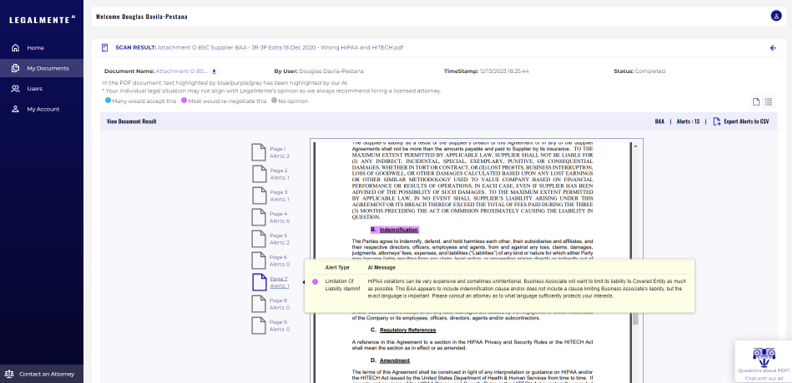
LegalMente AI is programmed to go through a legal playbook, highlighting issues and providing an easy-to-understand explanation for each concern. This level of detail ensures that our clients can make informed decisions about their healthcare and venture contracts without incurring excessive legal costs.
Additionally, lawyers can use LegalMente AI to speed up their own review time.
LegalMente AI is designed for anyone who deals with healthcare and venture capital contracts, including:
Physician Offices
Nursing Homes
Hospitals
Other healthcare providers
physical therapy, imaging centers, etc.
Healthcare vendors
Billing companies
Startups
Investors
Independent healthcare contractors
In-house healthcare lawyers
Law firms specializing in healthcare
Running a company is hard. Huge legal bills makes it harder.
With LegalMente AI, you can confidently navigate the complex world of legal contracts in healthcare and venture capital while saving time and money and having peace of mind. Let our advanced AI technology do the work for you, and experience the difference LegalMente AI can make in your business.

Learn how to form an LLC online, from choosing a state and name to filing paperwork, setting an operating agreement, and protecting your business now.

An AI paralegal for small business helps owners review contracts, draft documents, research questions, and control routine legal costs with confidence.

What Each Platform Actually Does Pricing: What You Actually Pay LegalMente AI Pricing in 2026 LegalZoom Pricing in 2026 Contract Review: The Feature That Matters Most for Founders LegalZoom’s Approach LegalMente AI’s RedFlag Detection™ Business Formation: LLC and Corporation Filing LegalZoom Formation LegalMente AI’s ParaForm™ Ongoing Legal Support: Where the Gap Widens LegalZoom’s Attorney Access Model LegalMente AI’s Conversational Paralegal Model Head-to-Head Feature Comparison Who Should Use LegalZoom Who Should Use LegalMente AI The Honest Bottom Line Frequently Asked Questions If you’re searching for a LegalZoom alternative, you’re probably already frustrated. Maybe you’ve hit a paywall mid-process, realized you needed a lawyer anyway, or simply felt like you were filling out forms rather than actually getting legal help. You’re not alone. And in 2026, there’s a more capable option worth considering. This comparison breaks down LegalZoom and LegalMente AI across the things that actually matter for startup founders and small business owners: pricing, contract review, business formation, ongoing legal support, and overall value. No filler, no spin. What Each Platform Actually Does Before getting into specifics, it helps to understand what each product is built for. LegalZoom is a document-generation service that has been around since 2001. It offers templates for LLCs, corporations, trademarks, wills, and other common legal documents. Its model is primarily form-based: you answer questions, it fills in a template, and you get a document. For some tasks, it connects you with attorneys for an additional fee. LegalMente AI is built differently. It’s an AI paralegal platform centered on Para™, a conversational AI Paralegal that answers legal questions, reviews documents you upload, flags potential issues in contracts, drafts documents, and helps you form business entities. It’s designed for founders and small business owners who need active legal support, not just a template library. The distinction matters. One gives you a document. The other helps you understand what you’re signing, what you’re filing, and what you might be missing. Pricing: What You Actually Pay Pricing is where the comparison gets interesting fast. LegalMente AI Pricing in 2026 Plan Monthly Annual Free $0 $0 Clerk $49/month $499/year Associate $99/month $999/year Partner $399/month $3,999/year Enterprise Custom Custom The free tier includes one contract review and limited access to Para™, enough to test the platform before committing. All paid plans include a Money-Back Guarantee. Business formation is available as a one-time purchase starting at $89, excluding state and third-party fees. LegalZoom Pricing in 2026 LegalZoom’s pricing varies by service. Business formation packages start at different price points depending on the state and the tier you choose, and many features that seem included upfront carry add-on fees. Attorney access typically requires a separate subscription or per-consultation fee. For ongoing legal questions or document review, costs can add up quickly. The core difference: LegalMente AI charges a flat monthly rate for ongoing AI paralegal access. LegalZoom tends to charge per service or per document, which makes it harder to predict your total spend. Contract Review: The Feature That Matters Most for Founders If you’re signing NDAs, client agreements, SAFEs, or vendor contracts regularly, contract review is probably your most frequent legal need. This is where the two platforms diverge most sharply. LegalZoom’s Approach LegalZoom can connect you with an attorney to review a contract, but that typically costs extra and involves scheduling time with a lawyer. The platform has a tool called Doc Assist which analyzes documents you upload, but it’s limited. You’re essentially paying for attorney time, which is useful but expensive and slow. LegalMente AI’s RedFlag Detection™ LegalMente AI built RedFlag Detection™ specifically for this problem. You upload a contract (PDF, Word, Excel, or even an image ) and Para™ analyzes it automatically, surfacing potential issues before you sign. It covers NDAs, BAAs, SAFEs, client agreements, and more. This isn’t a generic chatbot. The system is trained on legal knowledge built on a Harvard-graduate legal mind and backed by US-patented AI technology (Patent No. 12,333,959, USPTO). It reads the document the way a human paralegal would: looking for unusual indemnification clauses, one-sided termination rights, missing governing law provisions, and other terms that could hurt you later. For a founder signing contracts often and paying $600+ per hour for an attorney, this capability alone can justify the subscription cost. You can read more about what to watch for in contracts on the LegalMente AI blog, including a detailed breakdown of NDA red flags. Business Formation: LLC and Corporation Filing Both platforms help you form a business entity. Here’s how they compare. LegalZoom Formation LegalZoom has been doing business formation for over two decades and has strong name recognition in this space. It walks you through the process via a questionnaire and files the paperwork with your state. Higher-tier packages include registered agent service, operating agreements, and other add-ons. The downside: formation packages can get expensive when you add the features most startups actually need. And once the entity is formed, LegalZoom’s involvement in your ongoing legal questions depends on whether you’re paying for an attorney subscription. LegalMente AI’s ParaForm™ LegalMente AI offers ParaForm™, an AI-augmented business formation service powered in partnership with Padilla Law PLLC. The one-time fee starts at $89 (excluding state and third-party fees), which is competitive for straightforward formations. More importantly, formation doesn’t exist in isolation on the platform. After you file, Para™ is still there to answer questions about your operating agreement, equity structure, or what comes next. You’re not left with a document and no context. If you’re working through the early decisions of business entity setup, this LegalMente AI article walks through the key steps in plain language. Ongoing Legal Support: Where the Gap Widens This is arguably the most important dimension for early-stage founders, and it’s where the two platforms are most different. LegalZoom’s Attorney Access Model LegalZoom offers attorney consultations through its subscription plans, but you’re working with attorneys on a scheduled basis. It’s closer to a traditional legal service model: useful, but not instant, and not designed for the kind of

New startups often launch with 10 million authorized shares. Founders often ask me, “Why 10 million shares?” Before answering how many shares of stock a new startup should issue, founders must first understand the difference between authorized, issued, and outstanding shares. What Is The Difference Between Authorized, Issued, and Outstanding Shares? The number of authorized shares is the maximum number of shares that a corporation is legally allowed to issue to its investors and stockholders. When a corporation is formed, founders will submit a certificate of incorporation (also called the “charter”) to the appropriate Secretary of State. Among other things, the charter includes the maximum number of shares that the corporation is authorized to distribute or “issue.” Issued Shares are the number of authorized shares that the corporation has actually issued to all its stockholders. Legally speaking, the number of issued shares cannot be greater than the number of authorized shares. Outstanding shares are the issued shares that are currently outstanding. After being issued, a corporation may buy back shares that then are no longer outstanding. Think Of The Number Of Authorized Shares As Your Company’s Share “Limit” The number of authorized shares is much like a credit limit on a credit card. Let’s say you have a $5,000 credit limit and your ABC Corporation only has 5,000 shares authorized. The $5,000 limit is like the number of authorized shares — you cannot spend more than $5,000 credit limit, just like ABC Corporation cannot sell or grant more than 5,000 shares. Starting with its 5,000 authorized shares, let’s say ABC Corporation issues 2,600 shares. This is like the company spending $2,600 of its $5,000 “credit limit.” You have $2,400 left to spend in your credit line, and ABC Corporation has 2,400 shares left to issue. Issuing more shares than there are authorized makes those additional shares voidable. To issue more shares once you have reached the authorized limit, you need to amend the corporation’s charter, which usually requires approval from the board of directors and at least a majority of the existing stockholders (or whatever approval process the company’s charter or bylaws states). The stockholders might not be eager to approve of this change because increasing the number of authorized shares allows for the possibility to issue more shares that can dilute the ownership of existing stockholders. How Many Shares Do Startup Founders Need To Issue? The commonly accepted standard for new companies is 10 million shares. When you build a venture-backed startup designed to scale, you will need to issue shares to an increasing number of employees. Authorizing 10 million shares means it will be unlikely you’d ever need to offer someone a fraction of a share. A company can grant 10,000 shares to an employee which represents just 0.1% of 10 million shares. Psychologically, that works much better than giving ten shares which would be 0.1% of 10,000 shares. Also, the price per share will be lower. Let’s say two companies are each worth $1 million. One company has authorized and issued 10 million shares, while another has authorized and issued 1,000 shares. The first company would have a price per share of 10 cents per share. The second company would have a price per share of $1,000. As an investor, it can “feel” better to buy at a lower price. The quoted examples assume that the number of issued shares is at the maximum number of authorized shares. Out of a company’s 10 million authorized shares, founders are typically issued anywhere from 5 to 7 million shares. This practice makes sure that the founders always own a majority of the issued shares even when all 10 million shares have been allocated. To incentivize employees, startup founders reserve a percentage of the company to issue employees stock options or other equity incentives. This reserved number of shares is called the “option pool” and is most commonly the number equal to 10 to 20% of the currently issued shares. The remaining number of authorized shares that are not issued or reserved for issuance is available to investors, usually as preferred stock. How Do You Calculate The Ownership Percentage Of A Startup’s Shares? When calculating the percent ownership of a corporation, do not count the authorized shares. Instead, focus on the number of issued shares. In the example of a startup with 10 million authorized shares, 6 million are issued equally between two founders so that each founder owns 3 million shares, or 50%, of the company. If the founders wish to have a 10% option pool for employees, 600,000 shares are reserved for issuance as stock options (or other equity incentives). Please note that stock options give the right to purchase shares of stock but are not actually shares of stock, so a holder of stock options has no ownership in the company until the stock option is exercised. Summary Investors are used to seeing 10 million shares, but you can choose any number to authorize. The key is to have enough shares to issue additional shares to incentivize employees and to raise funds from investors without immediately having to amend your charter every time you wish to issue additional shares. This article lays out the distinction between authorized and issued shares as well as some strategies related to allocating them, but please note that this post (1) is not provided in the course of and does not create or constitute an attorney-client relationship, (2) is not intended as a solicitation, (3) is not intended to convey or constitute legal advice, and (4) is not a substitute for obtaining legal advice from qualified professionals. LegalMente AI – The One-Stop AI Legal ShopTM Lawyers are expensive. If you’re tired of high legal costs, you should consider using AI to help. LegalMente AI® uses artificial intelligence to reduce the cost of legal work for small businesses, startups, healthcare, and individuals. LegalMente’s software uses patent pending RedFlag DetectionTM AI technology to read and analyze common legal contracts with accuracy and speed.

There’s a critical choice founders must make when making a Section 83(b) election. The 83(b) election is a provision under the Internal Revenue Code that gives an employee or startup founder the option to pay taxes on the total fair market value of restricted stock at the time of granting. If one waits too long to decide, founders or employees granted company stock could face some profound tax implications. Let’s start with the basics. What is Restricted Stock? While many startup companies give stock options to employees, some grant restricted stock to its founders and certain employees. Restricted Stock is granted to a stockholder but limited in that it cannot be transferred or sold by that stockholder and may even be taken back by the company until certain conditions are met. Once met, the stock is released from the restrictions and said to be “vested.” If you are granted restricted stock, filing an 83(b) election might save you money on taxes, especially if you think the stock will become more valuable (and hence, result in a higher tax bill). It’s helpful to know how these elections work and when they may be useful. The steps required to file an 83(b) election are relatively simple. Should I file an 83(b) election? After you are granted restricted stock, you have 30 days to send an 83(b) election letter to the IRS to let them know that you want the stock to be taxed on the date it was granted. Otherwise, you will pay taxes on the date the stock vests. However, 83(b) elections may not be advantageous in every scenario. When deciding whether to file an 83(b) election, consider: How can I file an 83(b) election? If you decide to file, you should consult with a tax or legal professional to ensure that you correctly complete the process. To give you an idea of what’s involved, the necessary steps are: This article is not provided in the course of and does not create or constitute an attorney-client relationship. It is not intended as a solicitation, is not intended to convey or constitute legal advice, and is not a substitute for obtaining legal or tax advice from qualified professionals. LegalMente AI – The One-Stop AI Legal ShopTM Lawyers are expensive. If you’re tired of high legal costs, you should consider using AI to help. LegalMente AI® uses artificial intelligence to reduce the cost of legal work for small businesses, startups, healthcare, and individuals. LegalMente’s software uses patent pending RedFlag DetectionTM AI technology to read and analyze common legal contracts with accuracy and speed. Our AI Paralegal, ParaTM, can answer legal questions, analyze multiple file types, and help you form a business. Our Pre-Drafted Legal Document Templates contain templates for common legal contracts such as NDAs, BAAs, and SAFEs. And LegalMente AI can also help connect you to licensed attorneys.

Choosing the right legal structure is a critical decision for business owners in the US, and one of the most popular options is forming a Limited Liability Company (LLC). An LLC offers several advantages, including personal liability protection, flexibility in management, and various tax options. Unlike sole proprietorships, an LLC shields personal assets from business debts and legal liabilities. Additionally, members can choose whether to be taxed as a sole proprietorship, partnership, or corporation, depending on their financial goals. Types of LLCs Not all LLCs are created equal. There are several types of LLCs to consider, and choosing the right one is crucial for your business structure: Steps to Form an LLC in the United States Additional LLC Responsibilities Forming an LLC comes with ongoing responsibilities such as filing annual reports, paying state fees, and maintaining proper records. The costs vary by state, so be sure to check local requirements. For businesses operating in multiple states, “foreign qualification” might be required to do business legally across state lines. Keeping accurate records and consulting with an attorney or legal professional is essential to ensure compliance. Is an LLC Right for You? Deciding to form an LLC depends on your business goals. If you’re looking to protect your personal assets, offer flexibility in taxation, and simplify management, an LLC might be the perfect fit. However, it’s vital to assess your situation with professional advice to ensure you’re making the right choice for your business. LegalMente AI – The Future of Legal Work Traditional legal services have their place. However, high legal costs and inefficiencies are hard to ignore. Dealing with contract review doesn’t have to drain your wallet. LegalMente AI offers an innovative solution that addresses these challenges head-on. It provides quick, accurate, and cost-effective contract reviews. Step up to smarter, more affordable legal reviews with LegalMente AI. Sign up for a free user account today and say goodbye to those endless legal bills. LegalMente AI is free to use for everyone so you can start saving money today.
12951 Huebner Road, Unit 782315
San Antonio, TX 78278
2025 | LegalMente AI, Inc. | All rights reserved